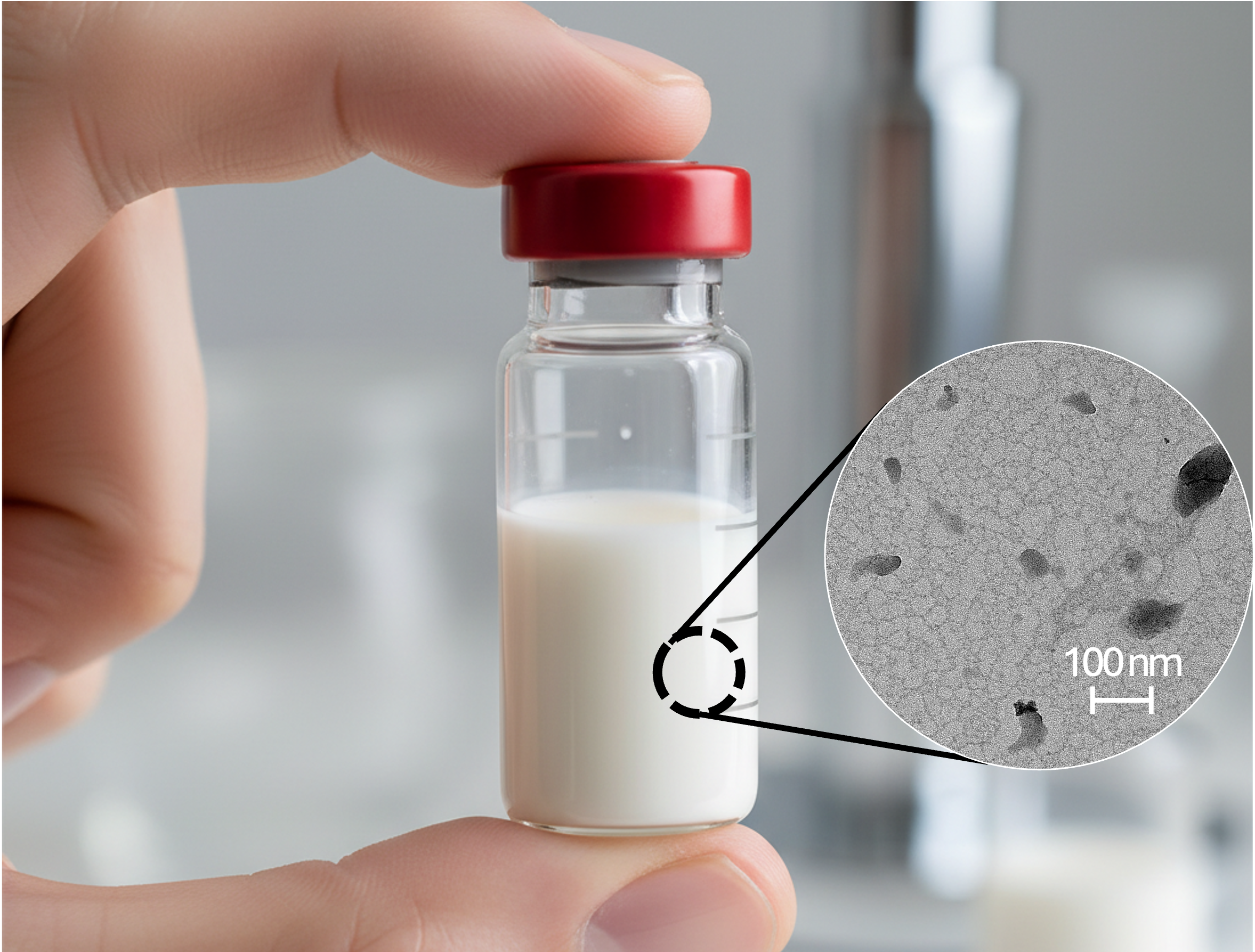
RealNP™ Nanoplastic Fragments

Nanoplastic fragment reference materials for biologically relevant research*.

Available for Research Use.

*trusted and used by ARPA-H STOMP proposers.

Our Customers and Users

Buck logo with a blue circle and black triangle, accompanied by the text 'Buck' and the slogan 'Live better longer'.
The logo of the television network NBC with the letters 'UCF' in bold, dark blue font on a white background.
Stanford University logo with a red and white shield and a green tree, accompanied by the text "Stanford University" in red.
UC San Diego university logo with stylized text and a gold underline.

Who We Are

Based at MBC BioLabs in the San Francisco Bay Area, we build tools that make biology more real.

We develop nanoplastic fragments and experimental systems that reflect real-world exposure, enabling more meaningful and reproducible research. We are supported by world-class scientific advisors across microplastics, immunology, and aging biology.

Modern office building at dusk with large glass windows, landscaping, parking lot, and a sign that reads "MBC biolabs."

Meet the Founder

Ik-Jung (Joe) Kim, Ph.D.

Founder

“Biology should be studied as it actually exists, not as we simplify it.”

Ik-Jung founded Myriad Labs after recognizing a critical gap in microplastic research. While studying how microplastic exposure may drive aging and chronic disease, he found that most studies rely on synthetic plastic beads that do not reflect real-world materials. He is now focused on addressing this bottleneck by producing mechanically generated micro- and nanoplastic fragments and making them accessible to enable biologically and environmentally relevant research.

Degrees and Training

  • Ph.D. at the School of Molecular and Cellular Biology, University of Illinois at Urbana-Champaign

  • Scientific scholar training at Stanford University

  • Postdoctoral Scholar/Scientist at the Buck Institute for Research on Aging

  • Scientist/Principal Investigator at the University of California, San Francisco

Publications: Google Scholar

ARPA-H STOMP ANNOUNCEMENT:

With the May 6th deadline approaching, we are currently prioritizing distribution of 100 nm-range polystyrene fragments.

Why 100 nm- range polystyrene fragments?

For TA1 application (Detection)

  • Defines the lower bound of STOMP requirements (100 nm–1 µm), providing a stringent test of sensitivity and limit of detection

  • Challenging size regime for quantification, enabling benchmarking of best-in-class analytical performance

  • Salt-free, detergent-free BIO formulation minimizes background interference and matrix effects

  • Well-suited for high-sensitivity platforms (e.g., mass spectrometry)

  • Small enough for cellular internalization, linking detection performance to biologically relevant exposure scenarios

For TA2 application (Understanding Biology)

  • Polystyrene serves as a de facto standard in microplastic research, enabling direct comparison to a large body of existing data

  • Mechanically generated fragments capture morphology and surface features absent in synthetic spheres

  • 100 nm size range is about the size of extracellular vesicles, enabling cellular uptake and interaction

  • BIO formulation is detergent-removed and minimally BSA-stabilized, reducing confounding variables

  • Provides a tractable, biologically relevant system for studying uptake, response, and protein corona formation

Interested in collaborating? We’d love to hear from you.

Sea turtle tracks on sandy beach with salt crystals and a few scattered leaves.

Let’s Stay in Touch

Any questions or suggestions? Please let us know.